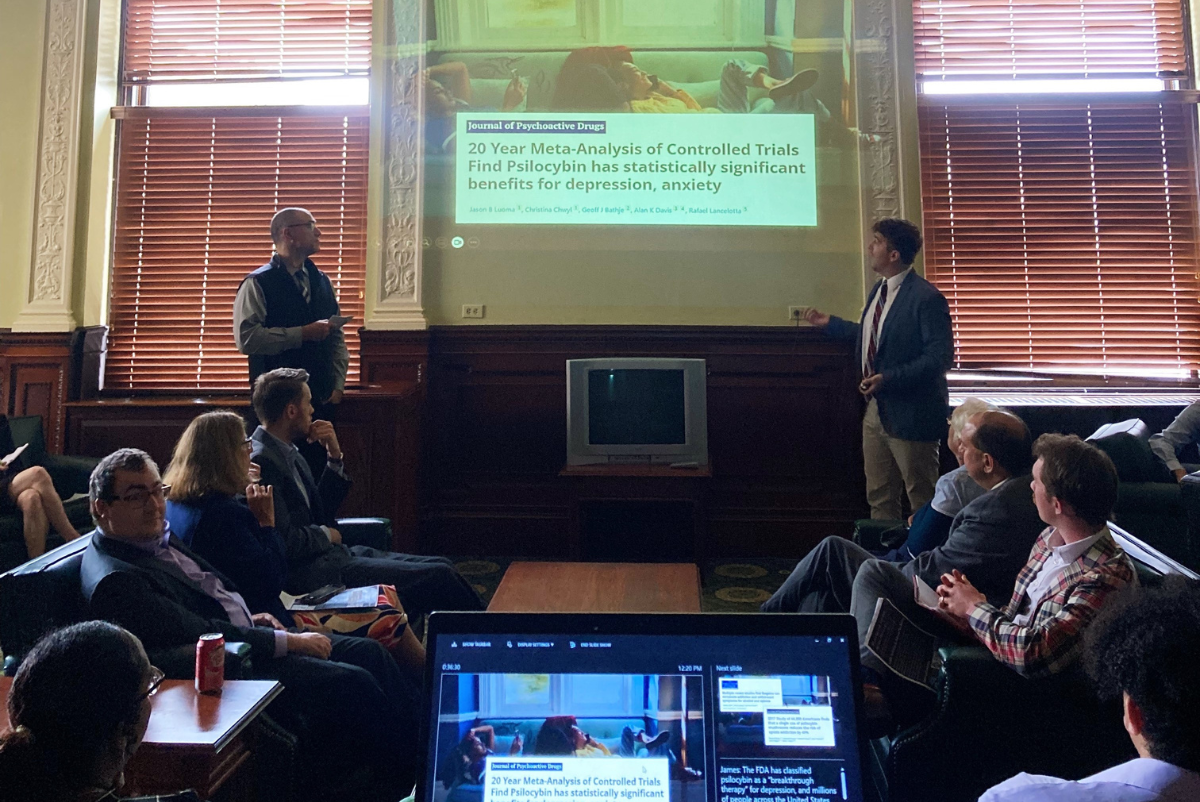
Returning from a long labor day weekend, it can be difficult to find Representatives and their staff willing to make the long commute to Beacon Hill. However, wall to wall attendance of more than 60 lawmakers and their staff at a private briefing on naturally-occurring psychedelics, made it clear that new approaches to mental health and addiction are a top priority.
Advocates described how psilocybin mushrooms and related plants can, for many, alleviate depression, opioid addiction, and rare neurological diseases like cluster headaches. Led primarily by psychotherapist Lieutenant Sarko Gergerian, an Officer with the Winthrop Police Department, and James Davis, the founder of Bay Staters for Natural Medicine, the presentation called on lawmakers to pass S.1009 and H.1754 An Act Relative to Plant Medicine. This bill, supported by Democrats Senator Jelen and Representative Sabadosa as well as Republican Representative Nick Boldyga, would allow adult residents to grow and share (without financial gain) a modest amount of psilocybin mushrooms with the goal of destigmatizing and educating people on their use for mental health.
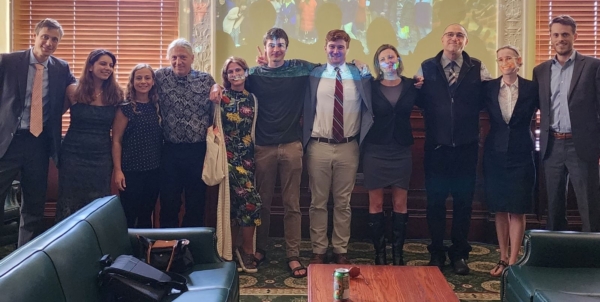
Massachusetts State House Event Brings Together 60 Officials
“Therapists, psychiatrists, and neurologists are afraid to discuss psychedelics with their patients. When we get this bill out of the Judiciary Committee, it will give these professionals the space they need to educate without fearing reprisal in their career,” remarked James Davis, who led efforts to pass psychedelic decriminalization measures across six Massachusetts cities.
Front and center in the discussion was the opioid crisis. A recent study of 44,000 Americans found that a single use of psilocybin reduces the risk of opiate addiction by 40%. Spotlighting a nearly $42 million investment the Commonwealth of Kentucky recently made into piloting a similar natural psychedelic, ibogaine, advocates called on lawmakers to make this a priority in its relation to public safety. “People who have used a natural psychedelic have a far reduced impulse to participate in the narcotics trade, engage in property crimes like theft, and have less violent tendencies. Fundamentally, this helps people work through their trauma and become a better person on the other side,” shared Lt. Gergerian, citing recent evidence.
Advocates also raised concerns about ballot measures filed in Massachusetts by a Washington-D.C. based super pac, “New Approaches,” that would create a strictly regulated framework for use.
“These measures are designed to mislead voters. They would create an unelected panel of bureaucrats with the ability to re-criminalize possession and cultivation of mushrooms to undo the protections Salem, Northampton, Easthampton, Amherst, Somerville, and Cambridge have put in place,” remarked Stephen Benjamin, a Franklin resident and U.S. Navy veteran helping lead New England Veterans for Plant Medicine. “We want lawmakers to pass an informed bill, not out-of-state money rigging our rules.”
The ballot measure rules, modeled on similar measures that narrowly passed in Oregon, would put strict regulations on use, restricting it to “healing centers” that have been expensive to operate.
“In Oregon, three years after voters approved that ballot measure, the average cost of a psilocybin facilitation session is almost $4,000. An average, or even upper-middle class family in the commonwealth is paying for school, they’re paying for their medical bills, they have transportation costs. That is ridiculous,” Davis said. Moreover, the state of Oregon was forced to give the regulatory authority overseeing the program a $6.2 million bailout from taxpayers because of a failure of the program to generate revenue for the state to even operate it.
The Super Pac responsible has not yet selected a ballot measure to move forward with, leaving open the possibility of spending tens of millions of dollars for a state law that would maintain jail sentences for people who grow their own mushrooms.